

Arizona Water and Fire
Water supply and wildfire risk affect Arizona homes more than most buyers expect. Deah’s reference guide points you to the agencies and checklists that matter.

Reference Guide
Water and Fire Know How
Water supply and wildfire risk shape Arizona homes in ways many buyers do not expect. This reference guide from Deah points you to the agencies, maps and checklists worth knowing about.
It is a courtesy guide and is not legal advice. Links and information may change, so confirm with the agencies and consult an attorney for water law questions.
Water Questions
Ask These About Any Property
Water Rights
Do you have rights to access and use the water on the property, and what are the legal uses? Ask if rights are grandfathered and whether surface water rights are senior or junior priority.
Hauled Water
Find out which haulers serve the property, the terms and cost of the agreement, where the water comes from and any limits on that source.
No Water
Consider whether you should build your own water portfolio and if water technology can broaden it.
Each Water Source
For every source ask if it could be compromised or unreliable, what the water quality is and how the provider manages its portfolio.
Districts and Fees
Is the property in a Community Facilities District, a water improvement district or an HOA, and do any of them deliver water or charge fees.
Check the Records
Look up the property in the state’s community water systems records and the ADEQ databases for Superfund and other sites.
Know the Terms
Water Alphabet Soup
You will see these acronyms in listings, disclosures and city documents.
AMA
Active Management Area. A region where the state regulates groundwater use.
INA
Irrigation Non Expansion Area. A region that limits new irrigated farmland.
AWS
Assured Water Supply. A program that requires proof of long term water for new subdivisions.
CAP
Central Arizona Project. The canal system that brings Colorado River water to central and southern Arizona.
CAGRD
Central Arizona Groundwater Replenishment District. Replenishes groundwater used by member properties.
DCP
Drought Contingency Plan. Sets how Colorado River shortages are shared.
Who to Ask
Water Agencies and Resources
Wildfire Safety
Know Your Home Ignition Zone
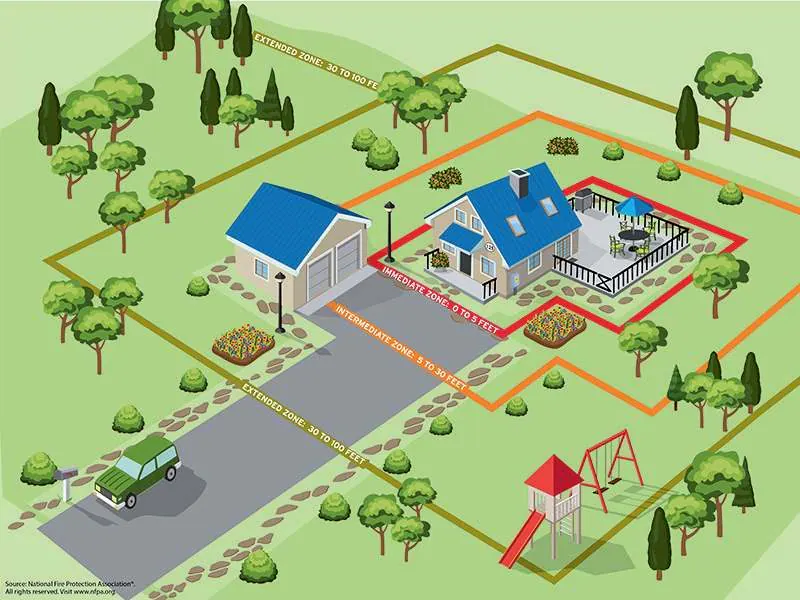
Research shows embers and small flames ignite most homes in wildfires, and the condition of the home and everything within 200 feet matters.
Immediate Zone
The home and the first five feet around it. This is the zone most vulnerable to embers.
- Clean roofs and gutters of debris
- Repair loose or missing roof tiles
- Cover vents with 1/8 inch metal mesh
- Move mulch, firewood and flammable plants away from walls
Intermediate Zone
Careful landscaping and breaks in vegetation that decrease fire behavior.
- Create fuel breaks with driveways, paths and patios
- Keep grass mowed to four inches
- Remove vegetation under trees and prune up
- Clear vegetation under propane tanks
Extended Zone
Out to 200 feet. The goal is to interrupt a fire’s path and keep flames small and on the ground.
- Dispose of heavy ground litter
- Remove dead plants and trees
- Clear vegetation near sheds and outbuildings
- Space tree canopies apart
Be Prepared
Prepare Your Home for Wildfire
Simple steps lower your risk and make your home safer.
- Choose fire resistant building materials
- Trim branches overhanging the home, porch and deck
- Remove plants with resins, oils and waxes
- Use crushed stone or gravel instead of mulch near the house
- Mark street names and numbers clearly and keep driveways 12 feet wide with 15 feet of vertical clearance
- Practice an emergency plan including pets and livestock, and know two ways out
- Evacuate early if you feel unsafe and do not wait for a notification
Learn More
Get the Full Reference Guide
The PDF includes links for water maps, well records, drought information, flood maps and wildfire preparation.
Keep Reading
More Buyer Resources
Free Consultation with Deah
Let’s Talk About Your Home Search
(425) 407-2800, any day 7 am to 7 pm
Tell Deah where you are in the buying process and what you are looking for. She will take it from there.
Call Now(425) 407-2800